Showing posts with label toes. Show all posts

Thursday, April 11, 2013

Reflexology

English: Foot reflexology is a "pressure ...
English: Foot reflexology is a "pressure therapy" and involves applying focused pressure to certain known reflex points located in the foot to cure or prevent disease. (Photo credit: Wikipedia)
Therapeutic reflexology, a popular therapy around the world, involves massaging the nerve endings of the feet to reduce stress and tension and promote healing in other areas of the body. The practice is based on the ideas that our body parts are reflected in the feet, with the front of the body on the sole of the feet and the back of the body on tops. For example, massaging the toes can help relieve headaches and other symptoms in the head. Massaging the ankle bone can help with hip problems. The feet have always played an important role in healing and reflexology dates back to 2500 BC. Some podiatric offices are now hiring therapeutic reflexologists as a complementary service.


It’s always a good idea to listen to your feet, as they often have lots to tell you, including giving you clues about the rest of your body’s well-being. When  your feet tell you there’s trouble somewhere, as your podiatrist, Shenandoah Podiatry will work as a team with you to keep you and your feet healthy and pain free. Feet that feel good mae the rest of you feel good, too so why not give us a call and start the process of feeling better today!

Enhanced by Zemanta

Friday, August 24, 2012

"He Got Cold Feet"

Cold Feet
Ever heard the saying, "He/She got cold feet," usually referring to backing out before a wedding ceremony? Well, where did it come from? How does "cold feet" have anything to do with having apprehensions about making a commitment?

After a little research, it seems there are a couple tales of where this phrase originated, which are pretty interesting!
  • The wartime usage of "cold feet" has led some to claim that the phrase originally referred to soldiers whose frost-bitten toes prevented them from entering a battle.
  • Hotfoot is used for someone keen to get somewhere - perhaps cold feet are the opposite
Have you heard of any other origins of the phrase "cold feet"? Share with us below!

Enhanced by Zemanta

Wednesday, August 1, 2012

Outrun Injuries

Zurich Marathon
Zurich Marathon (Photo credit: Wikipedia)
If a nagging ache is keeping you off the treadmill, track, or trail, the fix may be in your feet. Research recently published in Medicine & Science in Sports & Exercise found that runners who land on the ball of their foot are 40% less likely to have repetitive stress injuries than those who touch down heel-first.


"I don't recommend minimalist shoes if you have a history of chronic injuries or if you run extreme mileage. Runners can still run in adequate running form in regular running shoes, minimalist shoes aren't always necessary," Dr. Kate Steklachich, D.P.M.

Following the strategies listed to (slowly) switch up your strike:
  • Touching down with a stiff leg ups the force of impact, so keep a slight bend in your knee
  • Bend your back knee more than usual, and don't let your rear leg lag behind. This will help you take short, fast strides (aim for 165 steps a minute), lessening your injury risk.
  • When your foot hits the ground, it should be aligned with your hip.
  • Angle your foot slightly down and land on the outer ball of your foot, behind the second-to-last pinkie toes. After the front of the foot hits, let your heel naturally touch down, then push off your toes again to begin the next step.
source: Shape Magazine August 2012 Issue
Enhanced by Zemanta

Wednesday, July 11, 2012

Exercise Those Toes!

Many people underestimate the importance of keeping their toes physically fit. Toes take a lot of abuse from the hours we spend on our feet each day. The American Orthopaedic Foot and Ankle Society recommends doing the following simple exercises to strengthen your toes and prevent foot discomfort.
  • Toe raise, toe point, toe curl: Hold each position for five seconds and repeat 10 times. This especially recommended for people with hammertoes or toe cramps.
  • Toe squeeze: Place cigarette filters or small corks between your toes and hold a squeeze for five seconds. Do this 10 times. Recommended for people with hammertoes and toe cramps.
  • Big toe pulls: Place a thick rubber band around the big toes and pull them away from each other and toward the small toes. Hold for five seconds and repeat 10 times. Recommended for people with bunions or toe cramps.
  • Toe pulls: Put a thick rubber band around all of your toes and spread them. Hold this position for five seconds and repeat 10 times. This is especially good for people with bunions, hammertoes or toe cramps.
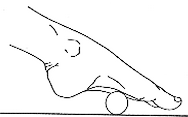
  • Golf ball roll: Roll a golf ball under the ball of your foot for two minutes. This is a great massage for the bottom of the foot and is recommended for people with plantar fasciitis (heel pain), arch strain or foot cramps. Towel curls: Place a small towel on the floor and curl it toward you, using only your toes. You can increase the resistance by putting a weight on the end of the towel. Relax and repeat this exercise five times. Recommended for people with hammertoes, toe cramps and pain in the ball of the foot.
source
  •  
  • Marble pick-up: Place 20 marbles on the floor. Pick up one marble at a time and put it in a small bowl. Do this exercise until you have picked up all 20 marbles. Recommended for people with pain in the ball of the foot, hammertoes and toe cramps.
  • Sand walking: Take off your shoes and walk in the sand at the beach. This not only massages your feet, but also strengthens your toes and is good for general foot conditioning.