Showing posts with label heel pain. Show all posts

Thursday, March 21, 2013

Avoiding Heel Pain

Heel pain is the most common condition leading patients to both our Roanoke and Blacksburg offices. Pregnancy, improper shoes, and overly strenuous exercise are some of the factors contributing to heel pain. Any heel pain that persists for more than a week should be evaluated by one of our podiatrists. To avoid heel pain, always consult a podiatrist before beginning any exercise program, especially if you have been inactive for a long time. Start any exercise program with moderation, gradually increasing the duration and intensity of your workouts.

Always stretch before and after exercise including calves and Achilles tendon. Vary the incline on a treadmill to avoid heel strain. Maintain properly fitting shoes in good condition, wearing appropriate shoes for various activities. When your feet cause you pain, there are many steps you can take to get relief. The first, and probably most important, is a visit to the podiatrist. If heel pain or any other foot problems have got you down, let us do what we do best- diagnose and treat the problem so you’re back on your feet quickly!

Wednesday, January 2, 2013

Take It Easy on Those Resolutions!

We all love the new year, it gives us a fresh start, hope and motivation for what's to come. Of course, this is the best part of the first of the year, especially since most people's resolutions are to lose weight and workout. Good for you! We can't encourage this enough. BUT we do have some suggestions- ease into the workouts!! Don't go all out- completing circuits, diving head first into crossfit, running 8 miles right off the bat. This is how you get injured! Start off by heading to the elliptical or do some modified HIIT training on the treadmill (or outside if it's warmer than Southwest VA-brrr!) or even rotations on the weight machines.

source
We are so glad you want to hit the gym- just be cautious! Here are a few common injuries by doing too much at once (over use injuries).
  • Achilles Tendonitis- Symptoms of Achilles tendonitis include mild pain after exercise or running that gradually worsens, a noticeable sense of sluggishness in your leg, and episodes of diffuse or localized pain, sometimes severe, along the tendon during or a few hours after running. Other symptoms can be swelling, morning tenderness in the Achilles tendon, or stiffness that generally diminishes as the tendon warms up with use.
  • Plantar Fasciitis- You may feel pain in the bottom of the heel, especially when first getting out of bed or after sitting for long periods of time. Usually the pain subsides but returns after spending long periods of time on your feet. Sometimes, it just hurts all of the time.
  • Stress Fractures- Symptoms can include pain and swelling.
Don't be the person who says, "these won't happen to me" because they might and they're not worth it! 

Wednesday, July 11, 2012

Exercise Those Toes!

Many people underestimate the importance of keeping their toes physically fit. Toes take a lot of abuse from the hours we spend on our feet each day. The American Orthopaedic Foot and Ankle Society recommends doing the following simple exercises to strengthen your toes and prevent foot discomfort.
  • Toe raise, toe point, toe curl: Hold each position for five seconds and repeat 10 times. This especially recommended for people with hammertoes or toe cramps.
  • Toe squeeze: Place cigarette filters or small corks between your toes and hold a squeeze for five seconds. Do this 10 times. Recommended for people with hammertoes and toe cramps.
  • Big toe pulls: Place a thick rubber band around the big toes and pull them away from each other and toward the small toes. Hold for five seconds and repeat 10 times. Recommended for people with bunions or toe cramps.
  • Toe pulls: Put a thick rubber band around all of your toes and spread them. Hold this position for five seconds and repeat 10 times. This is especially good for people with bunions, hammertoes or toe cramps.
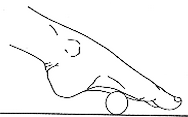
  • Golf ball roll: Roll a golf ball under the ball of your foot for two minutes. This is a great massage for the bottom of the foot and is recommended for people with plantar fasciitis (heel pain), arch strain or foot cramps. Towel curls: Place a small towel on the floor and curl it toward you, using only your toes. You can increase the resistance by putting a weight on the end of the towel. Relax and repeat this exercise five times. Recommended for people with hammertoes, toe cramps and pain in the ball of the foot.
source
  •  
  • Marble pick-up: Place 20 marbles on the floor. Pick up one marble at a time and put it in a small bowl. Do this exercise until you have picked up all 20 marbles. Recommended for people with pain in the ball of the foot, hammertoes and toe cramps.
  • Sand walking: Take off your shoes and walk in the sand at the beach. This not only massages your feet, but also strengthens your toes and is good for general foot conditioning.

Tuesday, June 5, 2012

Hunting & Hiking


Blue diamond-shaped sign used to designate hik...
Blue diamond-shaped sign used to designate hiking trails in provincial parks in Ontario, Canada. (Photo credit: Wikipedia)

Walking up and down steep hillsides and tramping through wet, slippery fields and wooded areas puts stress on the muscles and tendons in the feet and ankles, especially if you haven't conditioned properly before hitting the trail. Also, many don't realize that sneakers aren't the best choice for extended hiking and hunting. Had some of my patients worn sturdy, well-constructed hiking boots, they wouldn't have suffered sprained ankles or strained Achilles tendons.


Make the investment in top-quality hiking boots. Strong, well insulated and moisture-proof boots with steel or graphite shanks offer excellent ankle and foot support that helps lessen stress and muscle fatigue to reduce injury risk. The supportive shank decreases strain on the arch by allowing the boot to distribute impact as the foot moves forward. So if a boot bends in the middle, don't buy it.
In wet and cold weather, wearing the right socks can help prevent blisters, fungal infections and frostbite. Synthetic socks should be the first layer to keep the feet dry and reduce blister-causing friction. For the second layer, wool socks add warmth, absorb moisture away from the skin, and help make the hiking boot more comfortable.
For more information on taking care of your feet, visit http://www.shenandoahpodiatry.com/  


As brightly colored leaves dazzle the fall landscape, hikers and hunters nationwide will migrate to mountains, woods and fields, but many, unfortunately, are ill prepared for the beating their feet will take.

Hikers, hunters and others who love the outdoors often don't realize how strenuous it can be to withstand constant, vigorous walking on uneven terrain. Lax physical conditioning and inappropriate footwear bring scores of outdoor enthusiasts into our office each fall for treatment of foot and ankle problems such as chronic heel pain, ankle sprains, Achilles tendonitisfungal infections and severe blisters.
Enhanced by Zemanta

Monday, May 21, 2012

You're Active! So Keep Your Feet Fit!

Are you a daily walker, a hiker or a triathlete? Any level of intensity in your daily activities can create any of the serious and common injuries below.
Let's take care of your feet together, because healthy feet are happy feet!
Heel Pain- the most common complaint from runners caused by inflammation of the ligament which holds up the arc, known as Plantar Fasciitis

Causes:

  • Plantar Fasciitis is classified as an overuse injury, the same as tendonitis. Sudden increase of activities such as going on vacation, starting a new exercise routine or changing jobs can contribute.
  • Wearing non-supportive footwear on hard surfaces puts abnorman strain on the plantar fascia and can also lead to plantar fasciitis. This is particularly evident when one's job requires long hours on the feet.
  • During the summer months, we see an increased number of patients in our offices with plantar fasciitis due to walking barefoot or wearing flip flops. Obesity may also contribute to plantar fasciitis.
Neuromas- A neuroma is a thickening of nerve tissue that may develop in various parts of the body. The most common neuroma in the foot is a Morton's neuroma, which occurs at the base of the 3rd & 4th toes.

The thickening, or enlargement, of the nerve that defines a neuroma is the results of compression and irritation of the nerve. This compression creates swelling of the nerve, eventually leading to permanent nerve damage.
What Causes a Neuroma?
Anything that causes compression or irritation of the nerve can lead to the development of a neuroma. One of the most common offenders is wearing shoes that a tapered toe box, or high-heeled shoes that cause the toes to be forced into the toe box.
Tendonitis- The Achilles tendon is the largest tendon in the human body and is very strong, but is also the tendon we rupture most often. Everyone who is active can suffer from Achilles tendonitis, a common overuse injury and inflammation of the tendon.
Treatment depends on the degree of injury to the tendon, but normally includes rest, which may mean a total withdrawal from running or exercise for a week, or simply switching to another exercise, such as swimming, that does not stress the Achilles tendon.
A stress fracture usually occurs in the feet and legs. They are more common in sports like running or jumping, because this type of activity forces 2-3 times the person’s body weight onto the lower limbs. The biggest symptom with a stress fracture is pain with tenderness and swelling that worsens with weight-bearing exercise.
Make sure to see a podiatrist so we can keep you active into your late, late years!

Wednesday, May 16, 2012

Dancers Starting Pointe Earlier and Earlier

Yesterday I went to Dance-Tech in Blacksburg, VA to talk to the owner about Shenandoah Podiatry, she was so relieved to find out we are located just around the corner! She started talking to me about how so many of the young girls want to start Pointe classes earlier and earlier in age. The owner herself started at the young age of 8 and now shows the girls just what starting so young can do to your feet.
I think this is definitely a positive preventative measure to try to hold the girls off a couple more years, however, more than likely it goes in one ear and out the other!

After talking with the owner yesterday, I did a little research on common foot and ankle injuries dancers’ experience.
  •  Dancer’s Fracture (5th metatarsal fracture)- results in landing awkwardly on the outside  portion of the foot or twisting the ankle
  • Ankle Sprain- occurs by stretching or tearing one or more ligaments on either or both sides of the ankle.
  • Bunions- are caused by your big toe joints becoming incorrectly aligned. This causes the one bone on your big toe to slant outward and the second bone then angles towards your other toes.
  • Stress Fractures- results from too much repetitive activity of the foot which causes the bones to weaken
  • Ankle Impingement Syndrome- results on the front or back of the ankle and is related to bone structures that pinch the soft tissue when the ankle is pointed in one direction or the other
  • Turf Toe- a sprain caused by overuse or hyperextension
  • Heel Pain, Achilles Tendonitis, Sesamoiditis and Hallux Rigidus are all related to overuse and repetitive trauma
As much as we don’t mean to scare you with all of these common injuries, any daily activity can result in an injury so this is no announcement to stop your daily activities.
Shenandoah Podiatry is here to aid in foot and ankle health; if you hear any scary noises after a fall don’t do the “I’ll wait a couple days to see if the pain is still there.” The sooner you make an appointment the sooner you’ll be back on your feet!

Enhanced by Zemanta

Monday, May 14, 2012

Salem Sprint Triathlon

Who's attending the Salem Sprint Triathlon?!

Make sure to stop by our booth and get any last minute questions answered from your friends at Shenandoah Podiatry!!
For more information about the triathlon, visit ymcaroanoke.org

Wednesday, April 11, 2012

Foot Problems? Get them in shape for summer!

Come learn ways to get your feet in tip top sandal shape for summer! Dr. Kate will give suggestions on ways to treat bunions, hammertoes and heel pain as well as running tips (are you a heel striker?) to reach your PR!!

Bring your questions and get answers!
No pre-registration required, this is a FREE event!

Wednesday, January 5, 2011

Time Wounds All Heels - Literally

When John Lennon said, "I believe that time wounds all heels," I'm pretty sure he was referring to karmic justice and not our feet. But the literal interpretation isn't far from the truth!

Something we have seen patients complain of increasingly in our offices is heel pain - given many years, lots of walking, dancing, running, and general wear and tear, and wearing stylish-but-unsupportive shoes, it's no surprise that people's heels are hurting!

A common cause of heel pain is plantar fasciitis, meaning inflammation of the plantar fascia. The plantar fascia is a thick, broad band of fibrous tissue located at the bottom (plantar) side of the foot. It attaches to the heel as well as all five toes at the ball of the foot. The plantar fascia is not elastic like muscles are, so when we wear shoes with no arch support, our arches start to flatten and the plantar fascia pulls constantly where it is attached to the heel. This overworks the plantar fascia, causing it to become inflamed and irritated.

Given an infinite amount of time and many years of wearing unsupportive shoes, anybody could develop heel pain. If you're having heel pain, don't let your feet suffer anymore! Come see Dr. Feeny or Dr. Kate and they'll give you plenty of options to heal your hurting heels.

For more information, check out our website at http://www.blogger.com/www.shenandoahpodiatry.com.

Wednesday, June 30, 2010

Tarsal Tunnel Syndrome

Tarsal tunnel syndrome is a condition that is caused by compression of the tibial nerve or its branches.

Tarsal tunnel syndrome is analogous to carpal tunnel syndrome of the wrist.

The tarsal tunnel is a narrow space that lies on the inside of the ankle.

The tunnel is covered with a thick ligament called the flexor retinaculum.

Structures within the tarsal tunnel include:
-Arteries

-Veins
-Tendons
-Nerves


Tarsal tunnel syndrome is a compression on the posterior tibial nerve.
This syndrome produces symptoms anywhere along the path of the nerve.

Possible symptoms include:

-Tingling
-Burning
-Numbness
-Shooting pain
-Paresthesias

Contribute Factors to Tarsal Tunnel:
-Soft tissue masses:
Lipomas-is a benign tumor composed of fatty tissue
-Tendon Sheath Ganglia:
Neoplasms- is an abnormal mass of tissue as a result abnormal proliferation of cells
-Nerve tumors
-Varicose Veins

Work up:

Tinel sign- Percussion of a nerve with radiation of pain along the course of the nerve.

The doctor may order any of the following tests to help with the diagnosis:
-Electromyography (EMG) - A technique for evaluating and recording the electrical activity produced by skeletal muscles
-Nerve conduction velocity (NCV)
-Magnetic resonance imaging (MRI)- In cases of suspected soft-tissue masses and other space-occupying lesions
-Ultrasonography
-Radiography

Conservative Treatment:

-Rest
-Ice
-Non steroidal anti-inflammatory drugs-to help reduce pain and inflammation
-Immobilization- Restricting movement of the foot by wearing a cast or cam boot
-Physical therapy
-Injection therapy
-Orthotic devices. To control any abnormal bio mechanics of the foot


-Surgical Therapy

Tarsal tunnel release surgical intervention may be needed if conservative therapy fails to alleviate pain and symptoms. This procedure is used to decrease pressure on the posterior tibial nerve. Any space occupying lesions may also be excised.

                                                           Learn more at http://www.shenandoahpodiatry.com/

Wednesday, April 7, 2010

Plantar Fasciitis

Plantar fasciitis is one of the most common problems treated in a foot and ankle practice.


Approximately 10% of the United States population experiences bouts of heel pain.

The plantar fascia acts like a windlass mechanism.


The plantar fascia is made up of 3 distinct parts: medial, central, and lateral bands.


It extends from the heel bone to the metatarsal heads.
The plantar fascia is a thick band of tissue in the arch of the foot.


Etiology
Biomechanical dysfunction of the foot is the most common origin of plantar fasciitis.
The pathology is believed to be secondary to the development of microtears in the fascia
There is an inflammation at the fascia at its origin due to repetitive strain of the arch with weight bearing.


Symptoms
Most common complaint is pain in the bottom of the heel.
Patients will typically present with post–static dyskinesia. Pain with the first steps out of bed or periods of rest so it is usually worst in the morning and may improve throughout the day or with more activity.

By the end of the day the pain may be replaced by a dull aching that improves with rest.

Most people complain of increased heel pain after walking for long periods of time.
Generally the most common pain is that elicited upon palpation of the plantar-medial calcaneus
This is at the site of plantar fascial insertion to the heel bone. Pain can occur also at the central and sometimes at the lateral insertion as well.

A tight Achilles tendon can be an adjunctive finding and can contribute to the heel pain. This is known as an Equinus.


Diagnosis
Generally the diagnosis can be made with a good history.
X rays , MRI, and ultrasonography are important modalities to the diagnosis of plantar fasciitis.
X rays may reveal a plantar heel spur, which show the presence of abnormal stresses across the plantar fascia

A heel spur forms in a manner consistent with Wolff’s law. It should be noted that the heel spur is not the cause of the symptoms and therefore does not need specific treatment or removal.
MRI and ultrasonography shows the thickness of the fascia and helps rule out other problems that are not visible with x rays .

Treatment
Nonsurgical treatment include/ Conservative:
  • Rest
  • Icing
  • Stretching
  • Nonsteroidal anti-inflammatory medication such as Ibuprofen
  • Taping/Strapping
  • Orthoses (pre molded or custom-made)
  • Physical Therapy
  • Weight Loss
  • Corticosteroid Injections
  • Night Splints
These treatments should be used in combination.

Walking, running, and jumping sports are associated with plantar fasciitis; restriction of these activities may be necessary.


Surgical:
Severe cases may require surgical intervention if conservative therapy does not improve symptoms.

Extracorporeal shockwave therapy (ESWT) is an alternative treatment for chronic heel pain using acoustic-energy shockwaves

Plantar fascia release—performed by transecting part of the fascia - This is performed through an open incision or performed endoscopically

Another relatively new percutaneous technique is Topaz bipolar radiofrequency microdebridement, which applies a bipolar radiofrequency pulse to the plantar fascia.

Tuesday, October 6, 2009

Giant Hobbled by Heel Pain

Eli Manning, quarterback of the New York Giants, was recently diagnosed with plantar fasciitis. Plantar fasciitis is caused when the thick band of tissue running along the bottom of the foot, the plantar fascia, becomes inflamed. Symptoms include severe stabbing, burning, or aching sensations in the bottom of the foot and/or in the heel. These symptoms usually occur during weight bearing movements but may be present even when just standing. It’s obvious to see how this would cause difficulty for a quarterback to do his job. The QB sought council after he was diagnosed and immediately started treatment. He is hoping to practice with his team on Wednesday but for now his pain and ability to play is being judged day to day.

Being a quarterback for a professional football team is not the only profession where plantar fasciitis can cause problems. Almost any job or activity where frequent walking or standing on hard surfaces can cause this ailment. Pregnancy, obesity, and several other sports tend to make people prone to this injury as well.

Luckily for Eli and anyone who may suffer from plantar fasciitis, there is hope. There are several treatment options offered by podiatrists to correct this problem. Foot and heel pain does not have to be part of everyday life when correct council is available. Treatment can take anywhere from 6 to 18 months. When plantar fasciitis is caught in its early stages the recovery rate is dramatically reduced. Pain in the foot during the first few steps of the day (especially when first getting out of bed) is an early warning to call a podiatrist and get the feet checked out.

Take care of your feet today… so they can continue to take you the places you need to go tomorrow!